The Sardar Vallabhbhai Patel Stadium reveals itself gradually. Approached from the outside, it is neither concealed nor overtly announced. Concrete frames repeat and interlock, structure folding into structure, until scale becomes unavoidable. There is no single façade or ceremonial point of entry. The building asserts itself through accumulation rather than gesture. Time is visible on its surfaces, but the architecture remains intact. What is most striking on first encounter is the absence of activity. A stadium built for crowds is experienced in near silence, its vastness registered through empty circulation spaces and exposed structure. It feels less like a monument than a working artifact, present and functional, yet no longer central to the life it was designed to host. Its future remains uncertain.
Completed in the decades following Indian independence, the Sardar Vallabhbhai Patel Stadium was among the earliest large-scale cricket stadiums in the country and was regarded at the time as a significant engineering achievement. It was designed to host international matches and, for years, served as Ahmedabad’s primary cricket stadium for top-level matches. More than a sporting facility, the stadium functioned as a civic statement. Its scale and construction reflected a period in which architecture and infrastructure were closely tied to ideas of national progress and self-reliance. In this context, the stadium was not conceived as a landmark in the iconic sense, but as evidence of capability, a demonstration that a newly independent nation could design and build complex public structures on its own terms. That ambition is clearly expressed in the building’s architecture.
A Stadium Built for a New Nation
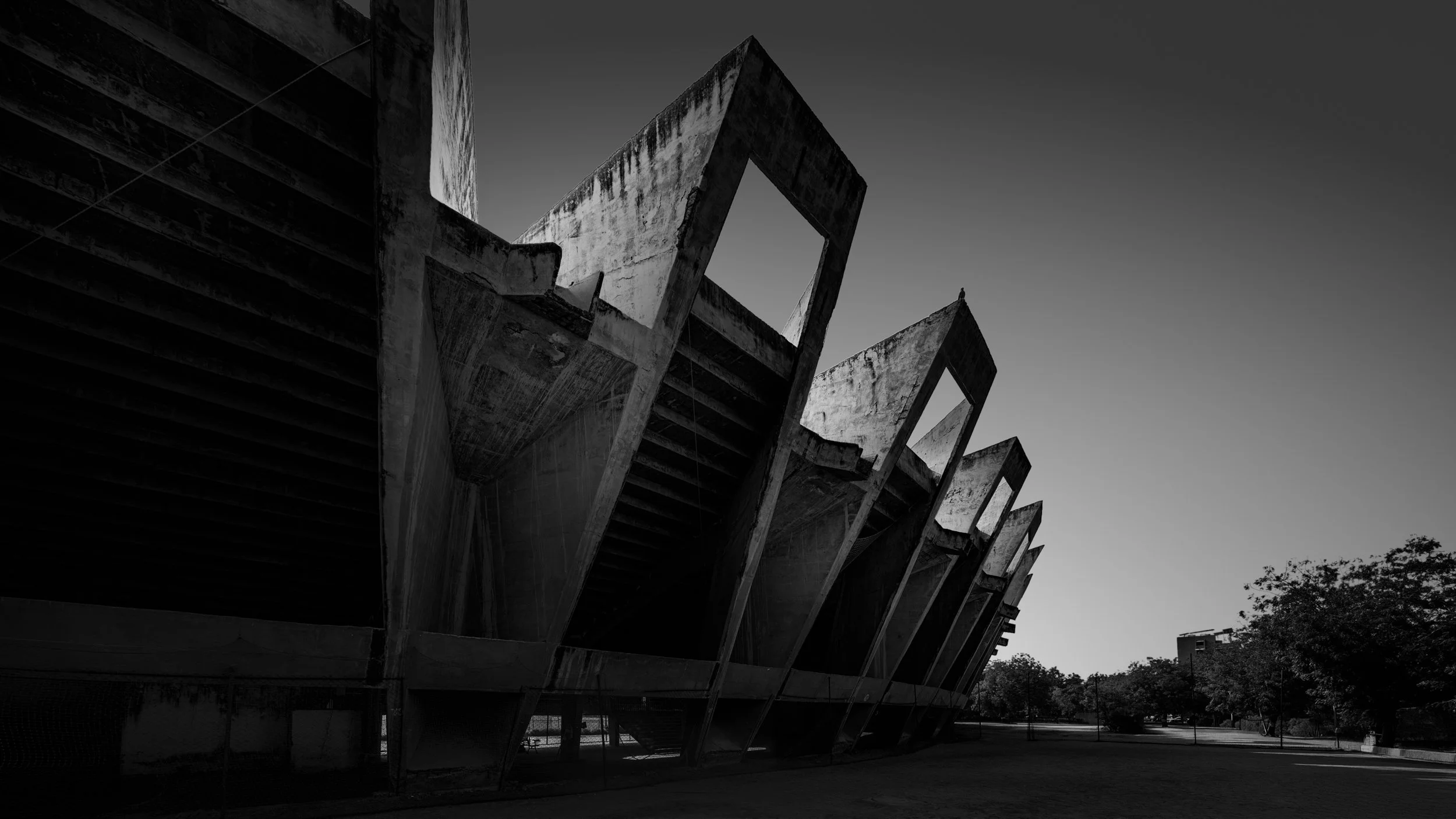
Exterior structure of the Sardar Vallabhbhai Patel Stadium in Ahmedabad, designed by Charles Correa, with exposed concrete frames expressing structural logic and scale.
The stadium’s architectural language is direct and uncompromising. Structure is not concealed behind surface treatment but made fully visible, expressed through repeating concrete frames and pronounced cantilevers. Load, support, and circulation are clearly articulated, giving the building a sense of logic that can be read from the outside. This emphasis on structural clarity aligns with the principles of Indian modernist architecture, where architecture was expected to explain itself, that form should emerge from necessity rather than decoration. In the context of post-independence India, such an approach carried additional weight. The building does not seek to impress through symbolism or excess, but through confidence in its own construction. Engineering becomes the primary means of expression, turning the stadium into a declaration of competence rather than spectacle.
The stadium was designed by Charles Correa, one of the most influential architects of post-independence India. Throughout his career, Correa sought to adapt modernist principles to Indian conditions, grounding his work in climate, culture, and patterns of use rather than adopting an imported architectural language. He rejected glass-heavy formalism in favor of clarity of structure, material honesty, and spatial logic. His architecture often balanced open and enclosed spaces, with form and proportions guided by use and environment. In the stadium, this approach is expressed through structural clarity and spatial openness rather than extensive enclosure. The vastness of the bowl remains largely exposed, while select covered areas provide shelter where it is functionally necessary. The result is an architecture that relies on engineering logic and spatial legibility, reflecting Correa’s belief that modern buildings should be legible and rooted in their context.
Modernism Without Spectacle
Seen in this light, the stadium represents a form of modernism that does not rely on spectacle. Its impact is cumulative rather than immediate, built through repetition, proportion, and structural consistency instead of iconic gestures. There is no single viewpoint from which the building can be fully grasped, and no image designed to summarize it at a glance. The architecture reveals itself through movement and use, through circulation paths, exposed structure, and changing perspectives. This approach stands in contrast to later stadiums that prioritize visibility, broadcast value, and instant recognition. In Correa’s stadium, architecture remains secondary to function, allowing the building to support events without becoming an event in itself. The absence of spectacle is not a shortcoming, but a deliberate position, rooted in an understanding of public architecture as a framework for collective experience rather than a symbol to be consumed.
From Center Stage to Margin
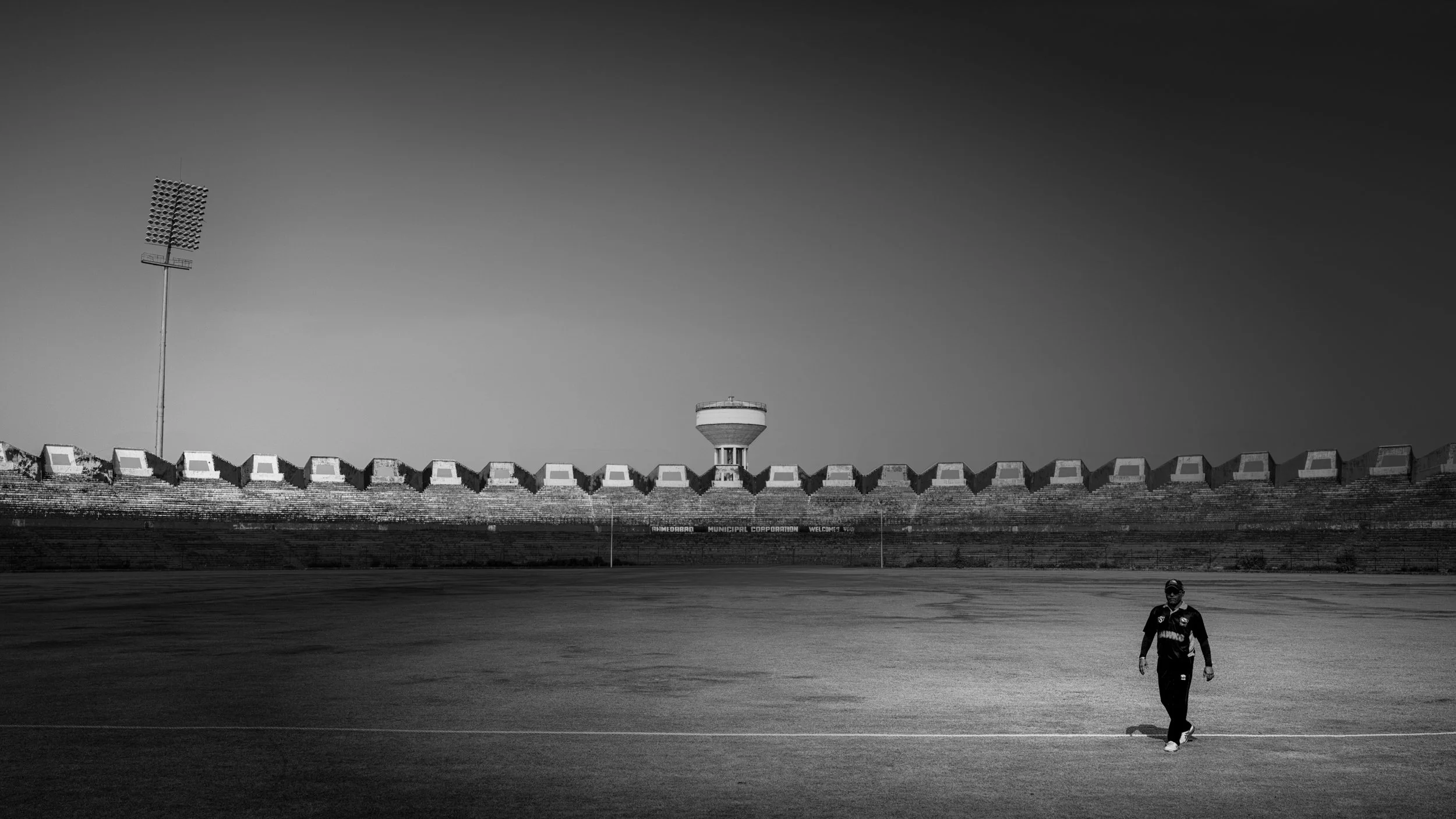
A wide view of the Sardar Vallabhbhai Patel Stadium in Ahmedabad during a local team practice, highlighting the contrast between the stadium’s scale and its current use.
For a period, the stadium fulfilled this role at the highest level. It hosted international cricket matches and functioned as Ahmedabad’s primary venue for the sport, embedded in the public life of the city. Over time, however, the logic that shaped its design began to lose relevance. International matches moved first to the newer Motera Stadium, which promised greater capacity and more contemporary amenities. That stadium, in turn, was demolished and replaced by the Narendra Modi Stadium, defined by scale and global visibility. In recent years, Correa’s stadium itself has faced the prospect of demolition, its future discussed in terms of redevelopment rather than continued use. Architecturally, it did not fail. It was overtaken by a changing idea of what a major public venue was meant to be.
Today, the stadium occupies a marginal position in the city’s sporting life. Its primary use is for training sessions and lower-profile domestic matches, events that unfold largely outside public attention. When I visited, the complex was open and unguarded. I walked in during a practice session by a local team, moving through circulation spaces once intended to accommodate large crowds without interruption. The contrast between the small group on the field and the vast, empty bowl around them created a sense of dissonance. The building’s scale remained unchanged, but its role had narrowed. The stadium continues to function, yet it does so quietly, no longer structured around anticipation or arrival, but around routine use.
These changes in use are reflected in the condition of the stadium itself. Signs of disinvestment appear in small, cumulative ways. Vegetation has begun to take hold in cracks between seating rows where crowds no longer gather, and facilities once essential to hosting large events, such as public toilets, remain locked and out of service. These details do not suggest collapse, but a recalibration of expectations. The architecture remains structurally sound, yet many of the systems that once supported its scale are no longer maintained or required. What has changed is not the building’s capacity, but the level of care and coordination directed toward it. The stadium continues to operate, but within a reduced framework of use.
Spatial Presence and Absence
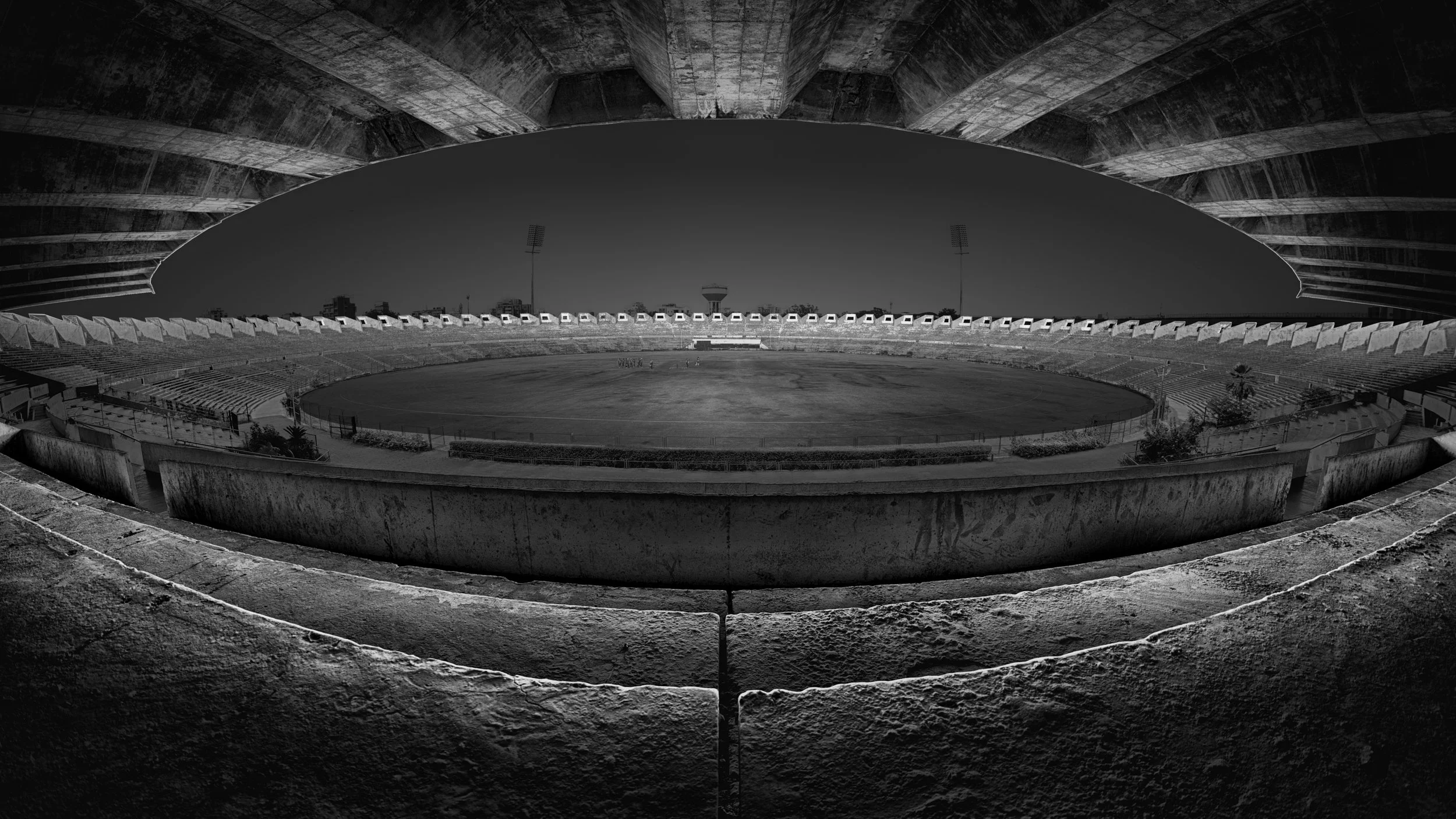
Interior panorama of the Sardar Vallabhbhai Patel Stadium, where the geometry of the bowl and seating focuses attention on the field in the absence of an audience.
Inside the stadium, the scale of the bowl remains its defining feature. The geometry is expansive and deliberate, shaped to hold large numbers while keeping the field visually central. From beneath the covered edge, the seating rises in a continuous sweep, enclosing an empty volume that feels both open and controlled. In the absence of an audience, the architecture becomes more apparent. Structure, proportion, and repetition register more clearly when no event competes for attention. The space was designed to absorb noise, movement, and collective energy, yet in its current state it holds only fragments of activity. The emptiness does not diminish the architecture, but it alters its meaning. What was conceived as a setting for mass participation now reads as a framework waiting for it.
The stadium’s interior reflects an approach to public space grounded in shared experience. The seating is organized to give spectators a similar view regardless of where they sit. Sightlines are consistent across the bowl, and no single position dominates the experience. Attention is directed toward the field itself rather than toward a hierarchy of seating zones. This spatial logic aligns with Correa’s broader interest in architecture as a social framework, one that supports gathering without prescribing how it should unfold. Even in its reduced state of use, the bowl retains this quality. The bowl remains open to different scales of occupation, capable of accommodating both large crowds and small, everyday activities without losing coherence.
What Endures
What becomes clear in this condition is that the stadium has outlasted the moment it was built to serve. The architecture remains capable, coherent, and structurally intact, even as the social and institutional frameworks around it have shifted. Its reduced role is not the result of architectural failure, but of changing priorities and expectations. The building was conceived for a form of public life that valued continuity, civic presence, and collective experience. Those values are still embedded in its structure, but they no longer align with how major sporting venues are now defined. The result is a quiet disconnect between what the architecture continues to offer and what is currently asked of it.
Observing What Lasts
Photographing the stadium in its current state became an exercise in attention rather than documentation. There was no event to record, only structure, scale, and the marks left by continued use. The images do not argue for preservation or dwell on loss. They reflect a moment of looking at an architecture that remains intact and functional, even as its role has narrowed. This way of working continues themes explored in earlier projects in India, such as Pink City, Black Dust, a photographic study of Jaipur shaped by atmosphere, urban structure, and architectural form. In a landscape shaped by constant replacement, observing such a building becomes a way of recognizing what endures.